
Level crossing rules are simple, but they leave no room for guessing. If the red lights flash, you stop behind the white line. You never drive onto the tracks unless the road beyond them is clear. That one habit prevents the worst crossing accidents.
Most Bolton learners meet crossings on drives out of town. The rules are the same everywhere in Great Britain. They sit in the Highway Code, rules 291 to 299. This guide explains them in plain English.
You may not meet a crossing every week. That rarity is exactly why preparation matters. Rare situations need rehearsed responses. A calm routine beats a panicked guess.
The one rule that prevents most crossing tragedies
Rule 291 sets the foundation. A level crossing is where a road crosses a railway line. Approach it with care, every time.
Never drive onto a crossing until the road is clear on the other side. Do not get too close to the car in front either. If traffic ahead stops, your car must not end up stranded on the tracks.
Never stop or park on a crossing. Never stop or park near one either. Queuing traffic is the classic trap. Learners follow the car ahead without checking the exit. Instructors watch for exactly that habit.
So build a routine. Slow down early. Look through the crossing to the far side. Only enter when your whole car can clear the tracks. This is basic stopping distance thinking applied to rails.

Amber, red, barriers: the sequence in plain English
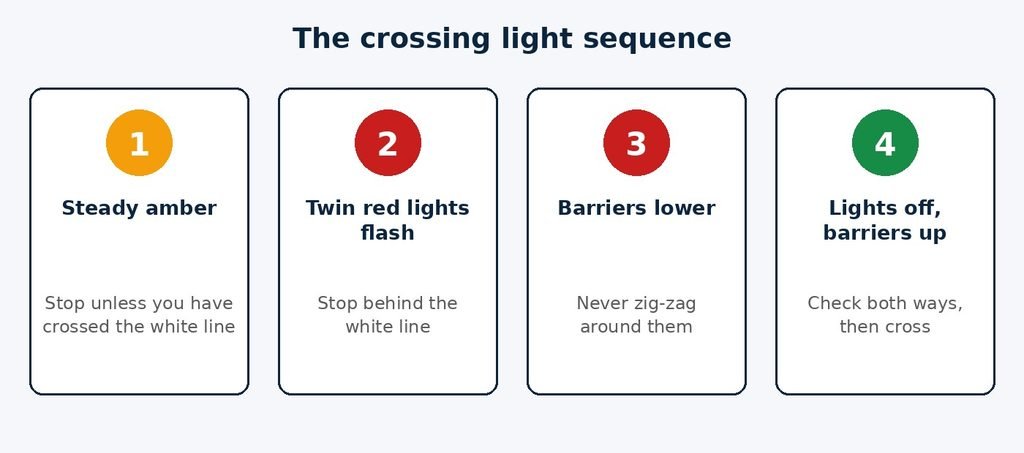
Controlled crossings use traffic lights. You will see a steady amber light first. Then twin red lights flash alternately. Many crossings also sound an alarm for pedestrians. Barriers may be full, half, or absent.
Rule 293 is strict about the red lights. You must always obey the flashing red stop lights. You must stop behind the white line across the road. There is no “just one more car” exception.
Amber needs judgement. Keep going if you have already crossed the white line. That applies when the amber light comes on. If you are still before the line, stop. Treat amber as “stop unless you cannot stop safely”.
Never reverse onto or over a controlled crossing. Never zig-zag around half-barriers. Barriers lower automatically because a train is approaching. At crossings with no barriers, lights showing means a train is coming.
Only cross when the lights go off. Wait for the barriers to open as well. Then check both ways before you move. The full rule text is on GOV.UK.
Why the lights can stay red after a train passes
This catches new drivers out. A train passes, so they start moving. But the red lights keep flashing. Rule 293 says you must wait in that situation. It means another train will pass soon.
That second train may come from the other direction. It may be hidden by the first train. So never treat one passing train as your green light. Your signal is the lights going off. Nothing else counts.
The same patience applies at half-barriers. The gap beside a barrier looks tempting. It is not an invitation. Driving around barriers is both dangerous and illegal. The flashing red lights carry legal force.
Instructors see this mistake in mock tests. The learner watches the train, not the lights. The level crossing rules treat the lights as the only signal. Train watching is a distraction. Light watching keeps you legal and alive.
Crossings with gates you open yourself
Not every crossing has lights and barriers. Rule 295 covers crossings without traffic lights. Stop and wait at the barrier or gate when it begins to close. Do not cross until it opens again.
Rule 296 covers user-operated gates. Some have Stop signs and small red and green lights. You must not cross when the red light shows. Only cross if the green light is on.
With a vehicle, open the gates on both sides first. Check the green light is still on. Cross quickly, then close the gates behind you. Rule 297 says to follow the same procedure where there are no lights.
Open crossings have no gates, barriers, or lights. Rule 298 says they carry a Give Way sign instead. Approach slowly. Look and listen both ways. Cross only when you are sure no train is coming.
Two more rules matter for bigger vehicles. Rule 292 covers overhead electric lines. Obey the safe height signs. Clearance is usually 5 metres, but it can be lower. Rule 294 covers railway telephones. Drivers of large, slow, or long vehicles must phone for permission when a sign tells them to.
These quieter crossings need more thought, not less. Nobody controls the gates for you. The level crossing rules still apply in full. Your eyes and ears replace the barrier machine. Slow down, look both ways, and listen.
If your car stalls or breaks down on the tracks
This is the scenario learners fear most. Rule 299 gives a clear order. Get everyone out of the vehicle. Move clear of the crossing immediately. Do that before anything else.
Next, use a railway telephone if one is available. Tell the signal operator what has happened. Follow the instructions you are given. Move the vehicle clear only if there is time before a train arrives.
One warning overrides everything. If the alarm sounds, leave the vehicle at once. The same applies if the amber light comes on. Get clear of the crossing immediately. No car is worth standing on the tracks.
A simple stall is different from a breakdown. Restart calmly and drive off if you can. But if the car will not move, follow rule 299. People first, car second, every time. Good mirror, signal, manoeuvre habits keep you calm under that pressure.
What examiners and theory questions expect
Level crossings appear in theory test questions. They can also appear on practical test routes. Examiners want to see the rule 291 habit. That means checking the exit before you enter.
Theory questions love the second-train trap. They also test the amber decision. Learn the level crossing rules as decisions, not trivia. Each light has one correct response. That framing makes the questions easy.
Approach at a speed that lets you stop. Stop behind the line on amber or red. Wait for lights off and barriers up. Then cross promptly without stopping on the tracks.
Hesitation causes problems too. Sitting still after the barriers lift blocks traffic. So the skill is balanced. Wait while the signals say wait. Move decisively once they clear. That balance is exactly what test day preparation builds.
Level crossing rules: quick answers
What does the amber light mean at a crossing?
It means stop, unless you have already crossed the white line. If you passed the line as amber appeared, keep going. Clear the crossing without stopping.
Can I cross after one train passes?
Only when the red lights go off and barriers open. If red lights keep flashing, another train is coming. Wait where you are.
What if there are no barriers?
Lights showing still means a train is approaching. Stop behind the white line. The absence of barriers changes nothing.
What should I do if my car stalls on the tracks?
Try to restart and drive off quickly. If the car will not move, get everyone out. Use the railway telephone and follow instructions.
Can I park near a level crossing?
No. Never stop or park on or near a crossing. Rule 291 forbids it. Keep the crossing and its approaches clear.
Do level crossing rules differ in Northern Ireland?
The Highway Code rules above apply in Great Britain. Northern Ireland has its own version. The core safety behaviour is the same.
Practise crossings with an instructor
Reading rules is one thing. Using them under pressure is another. A lesson can include crossing approaches on quieter routes. You will practise the exit check, the amber decision, and the wait. That practice turns panic into routine.
Bring your questions to the lesson. Ask about gates, telephones, and stalling. Practise the level crossing rules until they feel automatic. Calm drivers make better decisions at the lights.
Contact Driving Instructor Bolton to book a lesson. Tell us which crossings worry you. We will build them into your route planning.