
Few road markings cause as much hesitation, confusion, and panic for learner drivers as the yellow box junction. Designed with bright, criss-cross yellow lines painted directly onto the tarmac, these intersections are engineered to keep Britain’s busiest crossroads moving. Yet, for anyone preparing for their practical driving test in Bolton, a single misjudgment at one of these junctions can bring an immediate serious fault—or leave you with an expensive Penalty Charge Notice (PCN) in the post.
Whether you are negotiating the busy commuter corridors surrounding the Bolton Driving Test Centre on Weston Street or travelling through Bolton town centre during morning peak traffic, knowing exactly when you are legally permitted to enter—and when you must wait behind the line—is essential driving knowledge.
In this comprehensive guide, our DVSA-approved driving instructors break down the rules of the road, the famous right-turn exception, local Bolton junction hotspots, and the precise marking criteria examiners use on test day.
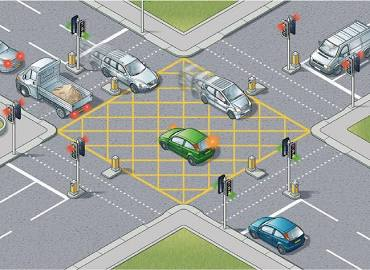
What Is a Yellow Box Junction and Why Does It Exist?
A yellow box junction is a traffic management road marking painted at busy crossroads, T-junctions, roundabout entries, and outside emergency service stations. Its primary purpose is simple: to prevent gridlock.
When heavy traffic builds up across a city, drivers queueing across open junctions block perpendicular traffic from crossing or turning. This results in complete stagnation where nobody can move. By reserving an open grid of road space, cross-traffic, public transit buses, and emergency service vehicles can proceed unimpeded whenever their lights turn green.
Under UK law—specifically The Traffic Signs Regulations and General Directions (TSRGD)—the criss-cross yellow lines create a legally enforceable box. Entering without a clear exit path constitutes a moving traffic violation.
Highway Code Rule 174: The Core Yellow Box Junction Regulations
The definitive legal authority governing every box junction in England, Scotland, and Wales is set out in The Highway Code Rule 174.
The fundamental rule states:
“You MUST NOT enter the box until your exit road or lane is clear.”
Highway Code
This is an absolute prohibition for through-traffic and left turns. It does not matter if the traffic light ahead of you is showing a bright green signal. If traffic on the road ahead is backed up and there is not enough physical tarmac on the other side of the yellow grid to accommodate your vehicle completely, you must stop before the entrance line.
The Overhang Trap
Many learners mistakenly believe that as long as their front wheels clear the box, they have complied with the law. This is incorrect. If any part of your vehicle—including your rear bumper—overhangs the criss-cross yellow lines and blocks oncoming or turning lanes, you are legally obstructing the yellow box junction.
The One Crucial Exception: Turning Right in a Yellow Box Junction
While the primary rule is strict, Rule 174 includes one vital, often misunderstood exception:
Safe Driving For Life
“However, you may enter the box and wait when you want to turn right, and are only stopped from doing so by oncoming traffic, or by other vehicles waiting to turn right.”
Highway Code
This exception exists because turning right across a flow of oncoming traffic requires you to pull forward into the middle of the junction to establish your turn. If you were forced to wait behind the stop line until oncoming traffic ceased, you might sit through multiple traffic light cycles without ever finding a sufficient gap.
When You CAN Enter to Turn Right:
- Your desired exit road on the right is completely clear and unobstructed.
- The only thing preventing you from completing the right turn is oncoming vehicles travelling straight ahead, or other motorists in front of you also waiting to turn right. Safe Driving For Life
- You pull forward smoothly into the box, position your car just before the centre point of the junction, keep your wheels aligned, and wait calmly. Once oncoming traffic clears (or the lights change to amber, halting oncoming traffic), you complete your turn cleanly.
When You CANNOT Enter to Turn Right:
If the road you intend to turn into is already backed up with stationary vehicles all the way back to the junction perimeter, you must not enter the box. Entering while your exit road is blocked means that if the oncoming traffic clears, you will remain stranded in the middle of the box, blocking oncoming motorists when their signal changes.
Safe Driving For Life+ 1
Signalled Roundabouts and Yellow Boxes
You will occasionally encounter a yellow box junction painted across lanes on large, multi-lane signalled roundabouts—such as those around the M61 link roads or Manchester Road.
The rules on signalled roundabouts carry a critical distinction:
- The right-turn exception does not apply on roundabouts. Safe Driving For Life
- Under Rule 174: “At signalled roundabouts you MUST NOT enter the box unless you can cross over it completely without stopping.” Highway Code
If you are following circular lanes around a roundabout and notice a yellow grid ahead controlled by traffic signals, scan ahead to make certain the queue past the lights has cleared before crossing the boundary line.
Yellow Box Junction Hotspots on Bolton Driving Test Routes
During your practical driving test from the Weston Street Driving Test Centre (BL3 2AW), the examiner will guide you through diverse road settings across Bolton, Farnworth, and Great Lever. Knowing where high-risk box junctions are located gives you an immediate strategic advantage.
[IMAGE: Tuition vehicle pausing before entering a busy yellow box junction in Bolton town centre | ALT TEXT: Tuition vehicle pausing before entering a busy yellow box junction in Bolton town centre]
1. Trinity Street & Newport Street (Near Bolton Interchange)
Located right outside Bolton railway station and the bus interchange, this is one of the most heavily monitored junctions in town.
- The Challenge: Buses, taxis, and commuter vehicles pull out constantly. Traffic heading along Trinity Street toward Moor Lane frequently backs up past the Newport Street intersection.
- The Risk: Approaching on a green light, learners frequently follow the car in front into the box, only for that car to brake suddenly behind a stationary bus, leaving the learner stranded on the yellow grid.
- Instructor Advice: Never look just at the car directly in front of you. Look through their windscreen or around their vehicle to see where the back of the queue sits. If there isn’t a clear car length on the other side, hold your position at the stop line.
2. Topp Way & Higher Bridge Street (A673 / A573)
Connecting traffic from St Peter’s Way (A666) into the northern side of town towards Astley Bridge, this wide multi-lane intersection handles fast-flowing traffic.
- The Challenge: Multiple lanes merge and split across wide spans of painted box markings.
- The Risk: Changing lanes mid-junction or miscalculating how quickly traffic beyond the lights is moving.
- Instructor Advice: Commit to your lane before entering. Maintain a steady approach in second gear and do not accelerate across the line until you visually confirm that your designated lane has cleared.
3. Blackburn Road & Lawson Street
Situated along the busy A666 corridor heading north, this junction features tight sightlines and constant pedestrian activity.
- The Challenge: Vehicles turning into side streets can stop abruptly to give way to pedestrians crossing the side road, creating an unexpected tailback that spills back into the yellow box.
- Instructor Advice: Always anticipate pedestrian movement. If a vehicle ahead is turning into Lawson Street, wait behind the box until they have fully completed their manoeuvre and vacated the carriageway.
How DVSA Examiners Mark a Yellow Box Junction on Your Driving Test
On your official DL25 driving test report, faults relating to box junctions are recorded under “Junctions – Observation” or “Junctions – Approach Speed / Compliance with road signs and markings.”
Here is how the examiner evaluates your performance:
| Candidate Action | Examiner Fault Level | Practical Test Result |
|---|---|---|
| Enters a box junction when the exit is blocked, coming to a complete stop and obstructing cross-traffic. | Dangerous Fault | Immediate Fail |
| Enters a box junction when the exit is blocked, stopping inside the box even if no cross-traffic is currently present. | Serious Fault | Immediate Fail |
| Waits unnecessarily behind the stop line to turn right when the exit is completely clear and only oncoming traffic is waiting. | Driving Fault (Minor) or Serious Fault (if repeated or causing significant delays to following traffic) | Up to 15 minors allowed; serious results in a fail |
| Pauses before the box on a green light because the exit is not yet clear, then proceeds smoothly once space opens up. | No Fault (Safe, Competent Driving) | Pass Standard |
During our professional driving lessons in Bolton, we teach you to develop the spatial awareness required to read these situations effortlessly, eliminating hesitation while preventing test-ending errors.
Bolton Council Moving Traffic Enforcement: Fines and Penalty Charge Notices (PCNs)
Understanding box junction rules isn’t just about passing your driving test; it also protects your wallet. Under Part 6 of the Traffic Management Act 2004, local councils outside of London have powers to enforce moving traffic offences using high-definition Automatic Number Plate Recognition (ANPR) cameras.
Bolton Council
As outlined in the Bolton Council moving traffic enforcement guidelines, five key yellow box junction locations across the borough are subject to camera monitoring to reduce congestion and improve road safety:
- Trinity Street / Newport Street Bolton Council
- Topp Way / Higher Bridge Street Bolton Council
- Blackburn Road / Lawson Street Bolton Council
- Bridge Street / St George’s Street Bolton Council
- Cricketers Way / Leigh Road (Westhoughton) Bolton Council
What Is the Penalty?
If your vehicle stops within a camera-enforced yellow box junction without qualifying for the right-turn exception, the registered keeper receives a Penalty Charge Notice (PCN) by post:
Bolton Council
- Standard Fine: £70 outside London. Safe Driving For Life
- Discounted Rate: Reduced to £35 if paid within 14 days.
- Penalty Points: Yellow box contraventions do not incur penalty points on your UK driving licence, but the financial sting is considerable. Motoring Research
4 Golden Rules for Tackling Any Yellow Box Junction
Follow this proven four-step checklist whenever you approach a yellow grid:
- Look Beyond the Box (Look Ahead, Not Down): As soon as you spot yellow cross-hatching on the road surface, switch your gaze immediately to the far side of the junction. Ask yourself: “Is there space for one full car length past the markings?”
- Never Trust Green Blindly: A green traffic signal grants you permission to proceed only if the way is clear. If the road ahead is congested, stop smoothly at the solid white stop line.
- Resist Pressure from Behind: Impatient drivers behind you may honk their horn or tailgate you, urging you to pull forward onto the yellow grid. Stand your ground. If you enter and get stuck, you will be the one receiving the £70 fine or the serious test fault—not the driver behind you.
- Master the Clutch Bite Point: When waiting to turn right inside the box, keep your car in first gear with the clutch pedal positioned near the clutch bite point and your handbrake ready if stationary for an extended period. When the gap in oncoming traffic appears, you can move off cleanly without rolling or stalling.
Preparing with Intensive Courses and Test Simulations
If complex junctions, high-speed dual carriageways like St Peter’s Way (A666), or tricky city-centre driving make you nervous, targeted training makes all the difference. Our [INTERNAL LINK: https://www.drivinginstructorbolton.uk/intensive-driving-courses/ | intensive driving courses in Bolton] feature dedicated junction modules where you will practice real-world scenarios across Bolton, Westhoughton, Horwich, and Farnworth.
By the time you sit your test via the [OUTBOUND LINK: https://www.gov.uk/book-driving-test | official DVSA practical test booking service], dealing with tricky road layouts will feel entirely routine.
Frequently Asked Questions
Can I enter a yellow box junction if only the back of my car stops on it?
No. Under TSRGD regulations, stopping any part of your vehicle inside the yellow box boundary while your exit is blocked constitutes an offence. Even having your rear wheels or boot overhang the markings can result in an ANPR penalty notice or a serious driving test fault.
What should I do if an oncoming car turns right and blocks my view?
When two opposing vehicles are both waiting inside a box junction to turn right, you will usually turn “offside to offside” (passing behind each other) or “nearside to nearside” (turning in front of each other). If their vehicle blocks your view of oncoming straight-ahead traffic, creep forward by millimetres until your sightline opens up. Never guess or accelerate blindly across oncoming lanes.
What if an emergency vehicle approaches while I am waiting before a box junction?
Do not panic and do not break the law by driving into the box if your exit is blocked. If safe and legal, pull over to the left before the junction to allow the emergency vehicle to pass. Emergency service drivers are highly trained and do not expect you to commit an offence or cause gridlock on their behalf.
Is stopping in a box junction an automatic fail on a driving test?
Yes, if you enter when your exit is blocked and stop because through-traffic prevents you from clearing the junction. However, if you enter to turn right and stop solely because of oncoming vehicles or vehicles waiting to turn right, this is fully permitted and incurs zero faults.
Safe Driving For Life
Master Bolton’s Roads with Driving Instructor Bolton
Tackling a yellow box junction does not have to be a nerve-racking ordeal. Once you understand the rules of observation, space estimation, and the right-turn exception, you can navigate even the busiest Bolton junctions with absolute poise.
At Driving Instructor Bolton, our experienced, DVSA-registered instructors are committed to building safe, observant, and resilient drivers. Whether you are starting your driving journey from scratch or need an advanced mock test before your exam at Weston Street, we provide the patient, structured tuition you need to succeed.
Ready to gain full confidence on Bolton’s roads? Visit Driving Instructor Bolton to book your driving lessons today and take your next step toward test-day victory.